

Introduction
Revision is the stage where a research paper becomes clearer, more defensible, and easier to evaluate. It is more than correcting grammar after the study is finished. A meaningful revision checks whether the question, methods, evidence, claims, and presentation still fit together.
Many authors begin with the easiest edits. They fix wording, adjust headings, or respond to comments one at a time while leaving a larger problem unresolved. A better process starts by identifying the changes that affect the paper's logic and credibility, then moves toward structure, clarity, and formatting.
This guide explains how to revise a research paper before submission. Use it after completing a draft, after receiving internal or reviewer feedback, or before preparing the final files for a journal.
What Does an Effective Revision Involve?
An effective revision connects every change to a reason. The reason may be a reviewer concern, a mismatch between the research question and the analysis, an unclear explanation, or a reporting requirement from the target journal.
| Revision area | What to check |
|---|---|
| Research question | Does the paper answer one clear and appropriately scoped question? |
| Evidence and methods | Are the procedures, analyses, and limitations described well enough to evaluate? |
| Claims | Does the language match the strength and scope of the evidence? |
| Structure | Does each section lead naturally to the next and support the main contribution? |
| Reviewer feedback | Has every substantive comment been addressed or explained? |
| Final submission | Are the manuscript, figures, references, declarations, and files complete? |
Revision works best as a sequence of decisions. First determine what must change, then make the change, check its effect on the rest of the manuscript, and review the updated version again.
How to Revise a Research Paper Step by Step
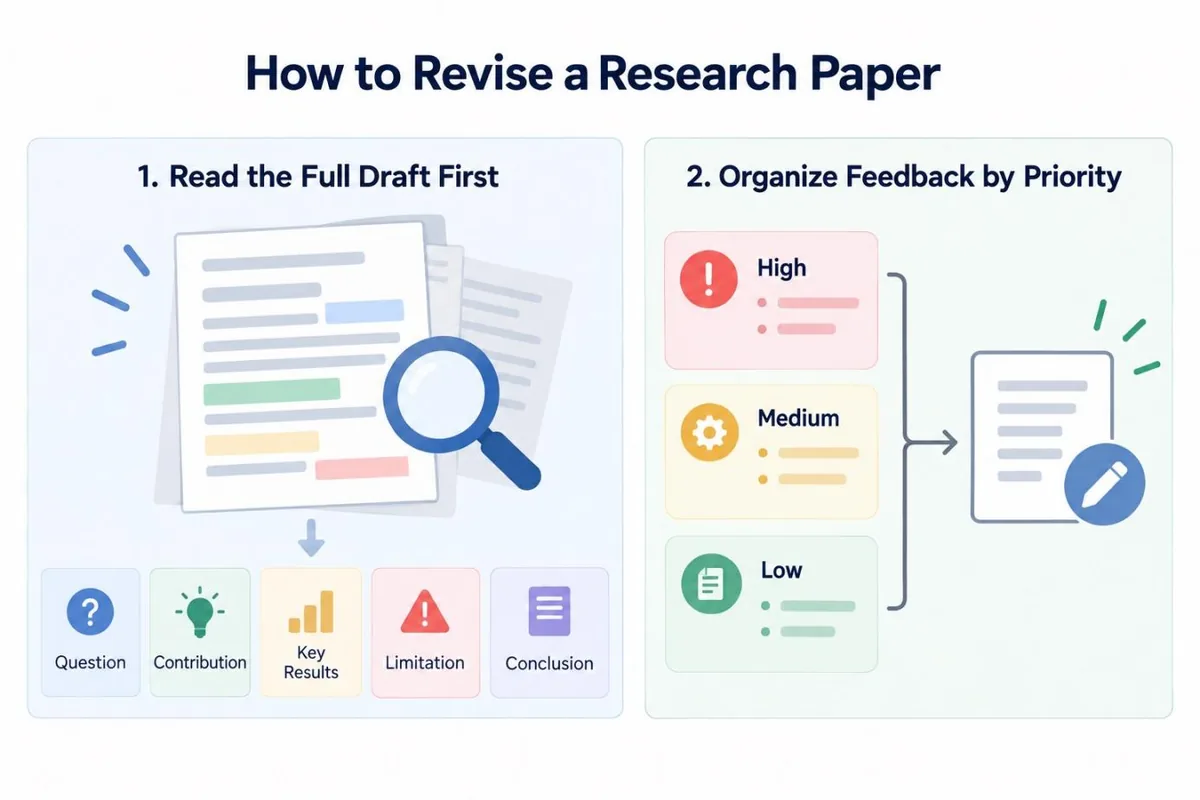
1. Read the Full Draft Before Editing Sentences
Read the paper once without trying to fix every sentence. Write down the research question, main contribution, strongest evidence, major limitation, and conclusion in your own words.
Then compare your summary with the Abstract, Introduction, Results, Discussion, and Conclusion. If the central message changes from section to section, revise the argument before polishing the prose.
Look for issues that affect the whole paper: a question that is too broad, an outcome that is not defined consistently, a method that does not support the conclusion, or a result that is emphasized more strongly than the evidence allows.
2. Organize Feedback by Priority
Separate feedback into three levels. High-priority issues affect validity, interpretation, or the main contribution. Medium-priority issues affect clarity, reporting completeness, or the connection between sections. Low-priority issues include grammar, formatting, and small wording changes.
Do not treat every comment as equally important. Several comments may point to one underlying problem, such as an unclear outcome definition or an unsupported causal claim. Group related comments before deciding how to revise.
If feedback conflicts, identify the reason for the disagreement. One reader may be asking for a narrower claim while another is asking for more context. The solution may be to clarify the study's scope rather than choosing one comment and ignoring the other.
3. Recheck the Research Question and Contribution
The Introduction should explain what is known, what remains uncertain, and what the study contributes. During revision, compare those statements with the actual design and results.
Narrow the question if the analysis cannot support the original scope. A study of one population, setting, or measurement may provide useful evidence without establishing a general effect. A precise contribution is stronger than a broad claim that the data cannot sustain.
Check the title, Abstract, final paragraph of the Introduction, first paragraph of the Discussion, and Conclusion together. These are the places where readers form their understanding of the paper's purpose and significance.
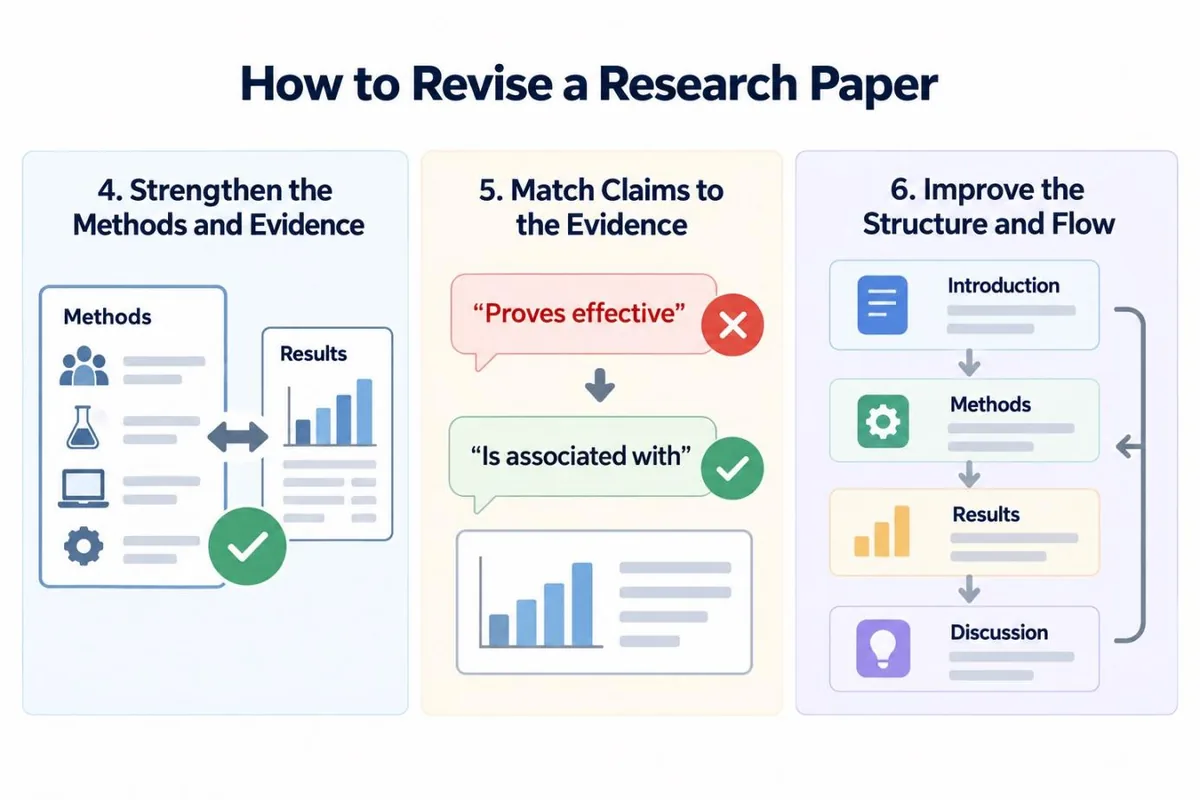
4. Strengthen the Methods and Evidence
Review the Methods as if you were a reader trying to evaluate or repeat the study. Add missing details about participants or samples, controls, procedures, measurements, software, analysis decisions, and quality control.
Check whether the Results use the same sample definitions, outcome names, and analysis terms as the Methods. Confirm that sample sizes, denominators, percentages, labels, and statistical values agree across the text, tables, figures, and supplementary files.
If a new analysis is necessary, explain why it was added and label it appropriately. Do not make a post hoc analysis look like a prespecified test. If a requested analysis cannot be performed, explain the limitation and state what evidence is available instead.
5. Match Claims to the Evidence
Review every major claim in the Abstract, Results, Discussion, and Conclusion. For each one, ask what result supports it, whether the evidence is direct or indirect, and whether the claim applies only to the studied conditions.
Replace language that is stronger than the design or data justify. Terms such as “proves,” “causes,” “always,” “safe,” “effective,” or “ready for clinical use” may imply more certainty or generalizability than the study supports.
Use precise alternatives when appropriate: “is associated with,” “suggests,” “may support,” or “warrants further evaluation.” This does not mean weakening every conclusion. It means matching the confidence of the language to the quality, size, design, and limitations of the evidence.
6. Improve the Structure and Flow
Each section should have a clear job. The Introduction establishes the question and gap. The Methods explains how the question was addressed. The Results presents the findings. The Discussion interprets them within their limits.
Remove repetition between the Results and Discussion. Keep observations in the Results and reserve interpretation, comparison with earlier work, and implications for the Discussion.
Use headings that tell the reader what the section covers. Add transitions where the logic changes. A paragraph should usually begin with its main point, provide the supporting detail, and end by showing why that detail matters to the argument.
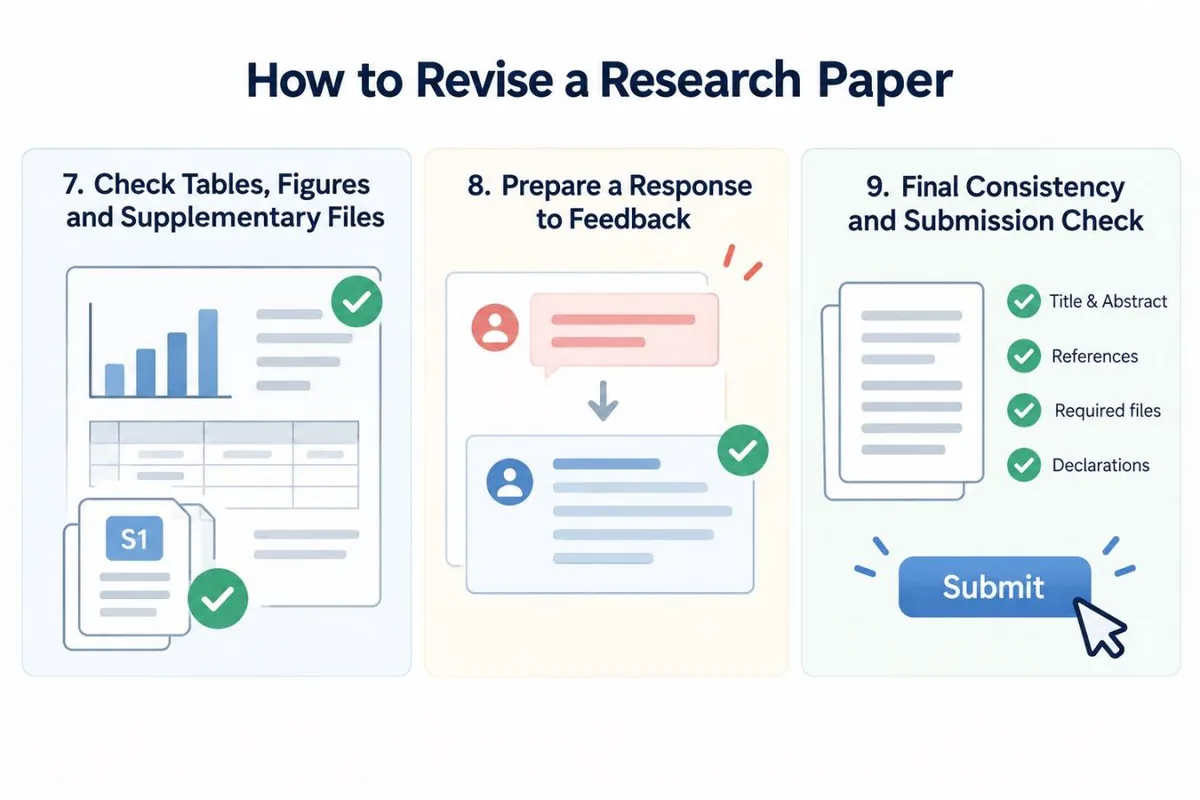
7. Revise Tables, Figures, and Supplementary Files
Check every figure and table against the text. Each should be cited in the correct order, have a clear caption, define abbreviations and error bars, and identify the relevant sample size.
Make sure the visual supports the claim made beside it. A visual pattern should not be described as a tested difference unless the analysis supports that statement. Remove decorative elements that do not help readers interpret the data.
Open supplementary files after making the revisions. Confirm that file names, versions, references, legends, and reported values match the main manuscript.
8. Prepare a Clear Response to Feedback
For reviewer or editor comments, create a response document that makes each change easy to locate. Quote or summarize the comment, state what you changed, and give the revised page or section location when required.
If you disagree with a suggestion, explain the scientific or practical reason calmly and provide evidence. A response should show that the concern was understood, even when the final decision is to keep the original wording.
Avoid claiming that a change was made when only a related sentence was edited. Check the final manuscript and response document together before submission.
9. Run a Final Consistency and Submission Check
After substantial revisions, read the complete manuscript again. Do not rely only on the tracked changes view or the list of edits.
Check that the title and Abstract describe the revised paper, all acronyms are defined, references are complete, and declarations for funding, ethics, data availability, and conflicts are present where required. Confirm the journal's word count, file format, figure resolution, anonymization, reporting checklist, and submission instructions.
Keep a clean final copy and a separate version that records the changes. Make sure the uploaded files correspond to the final version of the manuscript.
Common Research Paper Revision Mistakes
Editing Grammar Before Fixing the Argument
Surface-level edits cannot solve a question that is too broad, a missing control, or a conclusion that exceeds the evidence. Resolve high-impact issues first.
Responding to Comments Without Rechecking the Paper
A change in one section can create inconsistencies elsewhere. After each major revision, search the manuscript for the relevant term, number, outcome, or claim.
Accepting Every Suggestion Literally
Feedback is useful evidence about how readers understand the paper, but it still requires judgment. Combine related comments and choose revisions that improve the manuscript as a whole.
Hiding Limitations
Removing a limitation because it weakens the narrative can make the paper less credible. Explain how the limitation affects interpretation and what the study still supports.
Revising Without a Version Strategy
Unclear file names and multiple unfinished drafts increase the risk of submitting an outdated manuscript, figure, or response letter. Keep the final files together and label them clearly.
Frequently Asked Questions
When should I revise a research paper?
Revise after the main draft is complete, after receiving meaningful feedback, and again before final submission. Leave enough time between drafts to notice inconsistencies that are easy to miss while writing.
Should I make every revision requested by a reviewer?
No. Address every substantive concern, but use your judgment about the appropriate change. If you do not make a requested change, explain the reason clearly in the response.
How can I make a paper clearer without changing its meaning?
Shorten repeated explanations, define terms consistently, place the main point at the beginning of each paragraph, and check that every claim still matches the cited evidence after editing.
Should I accept all tracked changes before submission?
Prepare a clean final manuscript according to the journal's instructions. Keep the marked version separately if you need a record of the revision process or a response to reviewers.
Conclusion
A strong revision process improves the paper's reasoning before it improves its surface. Start with the research question, evidence, methods, claims, and reviewer concerns. Then refine the structure, language, figures, references, and submission files.
Review the manuscript again after making changes. The final goal is a paper that another researcher can understand, evaluate, and place in context without having to guess what the authors intended.
PaperProof
Revise Your Manuscript With More Confidence
Use PaperProof’s Revision Assistant to organize feedback, clarify unclear sections, and review the manuscript again before submission.
Organize your revision