

Introduction
Submitting a research paper is not only a test of whether the study is interesting. It is also a test of whether another researcher can understand what you did, evaluate the evidence, and see how the results support your conclusions.
A final review before submission helps you find problems while you can still fix them. It can reveal a research question that is too broad, a methods section that leaves out important details, a conclusion that goes beyond the data, or a claim that needs stronger evidence.
This review is different from proofreading. Proofreading improves grammar and formatting; a research paper review checks whether the study is logically designed, clearly reported, and supported by its evidence.
This guide explains how to review a research paper before submission. Use it as a complete checklist, or focus on the sections most relevant to your study.
What to Check Before Submitting a Research Paper
Review the paper in this order. Start with the logic of the study, then examine the evidence and reporting details. This helps you fix high-impact problems before spending time on minor wording changes.
| Review area | Questions to ask |
|---|---|
| Research question | Is the question specific, important, and answerable with the chosen study design? |
| Introduction | Does the background lead clearly to the research gap and study objective? |
| Methods | Are the participants, materials, procedures, controls, and analysis methods described clearly? |
| Results | Do the results answer the research question without adding unsupported interpretations? |
| Evidence | Do the data support each major claim, and are uncertainty and limitations reported? |
| Discussion | Are the findings interpreted in context without overstating their meaning? |
| Reproducibility | Could another researcher understand and repeat the work from the paper and its supporting files? |
| Presentation | Are the title, abstract, figures, tables, references, and declarations complete and consistent? |
Research Question, Study Design, and Methods
1. Check the Research Question and Main Contribution
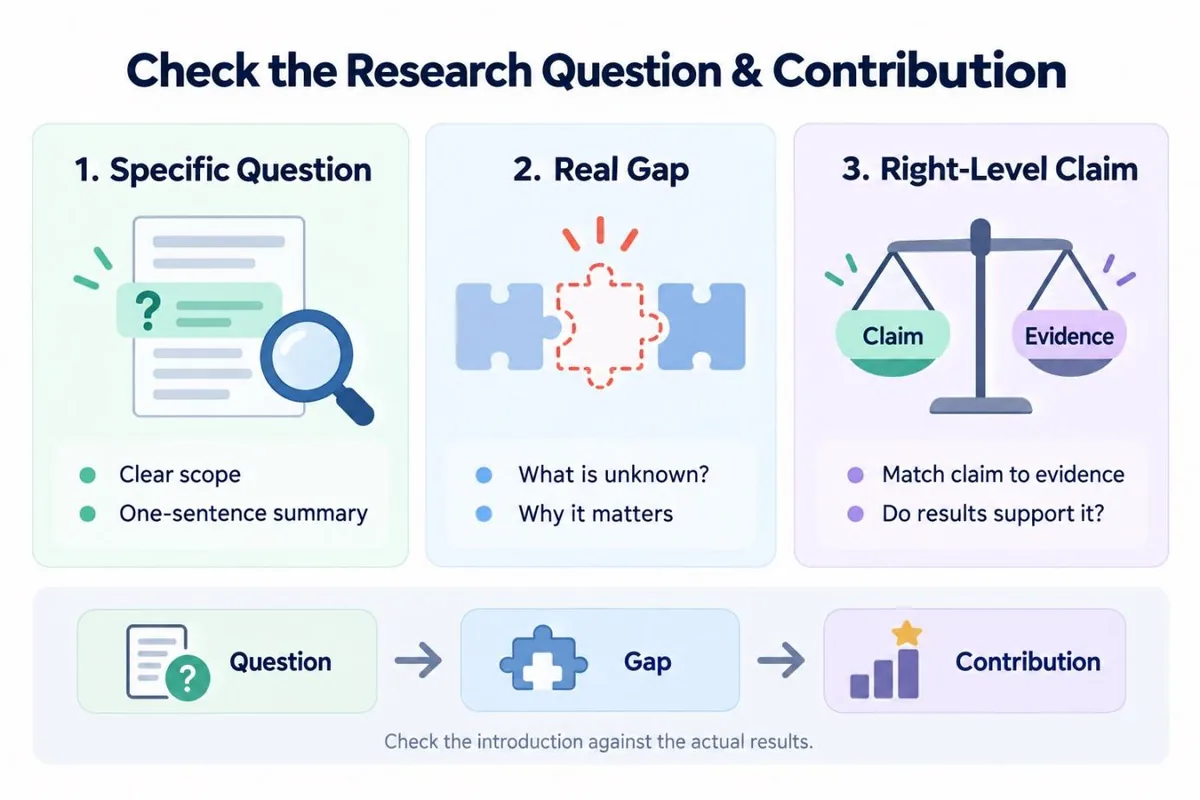
Begin with the research question rather than the grammar. A paper can be well written and still be difficult to evaluate if the central question is unclear.
Is the research question specific?
The question should identify what is being studied, in which population or system, and under what conditions. Terms such as “improves,” “affects,” or “important” may be too broad unless the paper defines how they are measured.
Ask whether a reader could summarize the question in one sentence. If the answer changes from the Introduction to the Abstract or Discussion, the scope of the paper may need to be narrowed.
Does the study address a real gap?
The Introduction should explain what is already known, what remains uncertain, and how this study addresses the uncertainty. A list of citations is not enough. The paper should show why the gap matters and why the chosen approach is appropriate.
Is the contribution stated at the right level?
The contribution should match the evidence. A small experimental study may provide evidence for a mechanism in a defined setting, but it may not establish a general clinical or real-world effect.
Check the final paragraph of the Introduction and compare it with the actual results. If the promised contribution is broader than what the study tests, revise the claim before submission.
2. Evaluate the Study Design and Methods
The Methods section lets readers judge whether the study can answer its research question. Missing or vague details make it difficult to assess the reliability of the findings, even when the results appear convincing.
Does the design match the question?
An observational design, randomized experiment, validation study, or computational analysis answers a different kind of question.
Check that the design supports the type of conclusion the paper makes. For example, an association study should not be written as proof of causation unless the design and analysis justify that interpretation.
Are the samples and controls appropriate?
Review how samples were selected, how many were included, and why they were suitable for the study. Check inclusion and exclusion criteria, biological or technical replicates, control groups, and any matching or balancing procedures.
Controls should test the explanation the study proposes. A negative control can reveal background or nonspecific effects, while a positive control can show that the system is capable of producing the expected response.
If a control is missing, explain the limitation rather than implying that the result is fully validated.
Is the procedure detailed enough?
Another researcher should be able to understand what was done without guessing.
Check the description of:
- Materials
- Instruments
- Software
- Protocols
- Timing
- Randomization
- Blinding
- Preprocessing
- Data exclusion
If a standard protocol was followed, cite it and describe any changes made for this study.
Is the analysis plan appropriate?
Confirm that the statistical or computational methods match the data type and study design.
Check assumptions, missing data, outliers, normalization, multiple comparisons, effect sizes, confidence intervals, and sensitivity analyses where relevant.
Do not judge analysis only by whether a result is statistically significant. A small p-value does not establish practical importance, and a non-significant result does not prove that there is no effect.
The paper should report the size and uncertainty of the finding as well as the test result.
For a structured check of study design, methods, controls, and analysis, use PaperProof’s AI Manuscript Checker as a second set of eyes before submission.
Results, Evidence, and Claims
3. Check Whether the Results Answer the Question
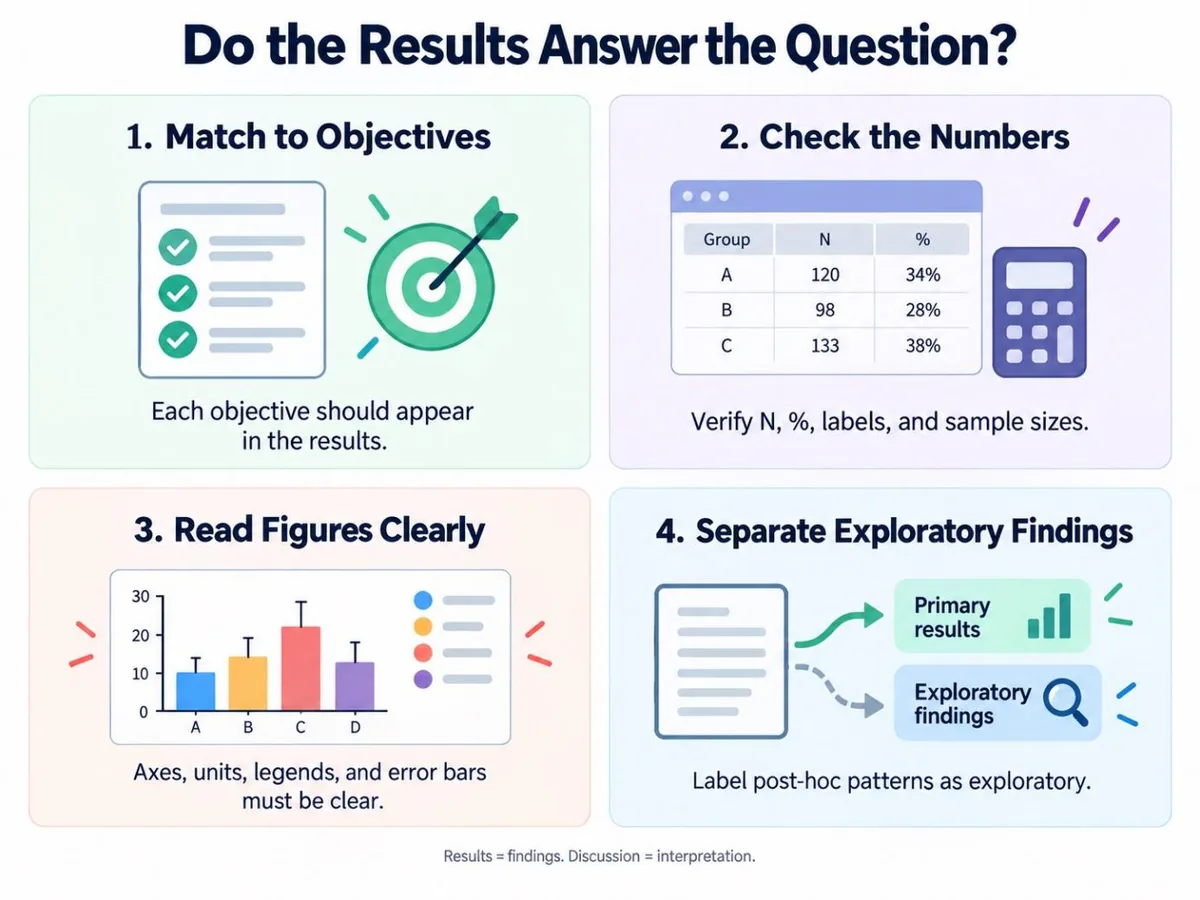
The Results section should present what the study found. Interpretation belongs mainly in the Discussion.
Mixing the two makes it harder for readers to distinguish observations from conclusions.
Match each result to an objective
Review the objectives in the Introduction and identify where each one is addressed in the Results.
If an analysis appears that was not planned or explained, add the rationale or remove it. If an important objective is not addressed, state why and describe the limitation.
Check the numbers across the paper
Compare the Abstract, main text, tables, figures, supplementary files, and reported sample sizes.
Look for:
- Inconsistent denominators
- Percentages that do not match raw counts
- Mismatched labels
- Conflicting sample sizes
- Rounded values that change the interpretation
Figures should be understandable without extensive searching. Check axis labels, units, legends, sample sizes, statistical annotations, and whether error bars are defined.
A visual pattern should not be described as a tested difference unless the analysis supports that statement.
Separate exploratory and confirmatory findings
If an analysis was added after looking at the data, describe it as exploratory.
Avoid presenting an unexpected pattern as though it were the original hypothesis. Clear reporting of exploratory work increases trust and helps readers judge how strongly the finding should be interpreted.
4. Test the Link Between Evidence and Claims
A strong research paper does not only present data; it explains exactly what the data support.
Review every major claim in the Abstract, Results, Discussion, and Conclusion.
For each claim, ask:
- What result supports this statement?
- Is the evidence direct or indirect?
- Does the claim apply only to the studied sample and conditions?
- Are important alternative explanations still possible?
- Is the wording stronger than the data justify?
Watch for terms such as “proves,” “causes,” “always,” “safe,” “effective,” or “ready for clinical use.”
These words often imply more certainty or generalizability than a single study can establish. Replace them with precise language such as “is associated with,” “suggests,” “may support,” or “warrants further evaluation” when appropriate.
This does not mean making every conclusion vague. It means matching the confidence of the language to the strength, design, size, and limitations of the evidence.
Discussion, Limitations, and Reproducibility
5. Review the Discussion and Limitations
The Discussion should help readers understand the meaning and boundaries of the findings. It should not repeat the Results or introduce a new set of unsupported claims.
Explain the main finding first
Open with a direct statement of what the study adds.
Then compare the finding with relevant prior research and explain possible reasons for agreement or disagreement. Avoid turning the Discussion into a second literature review that obscures the study’s own contribution.
Treat limitations as part of the interpretation
A limitation is useful when it explains how the result should be interpreted. Describe its likely direction and effect where possible.
For example, a small sample may reduce precision, while selection bias may limit generalizability.
Simply writing “more research is needed” does not show how the current study should be understood.
Keep the conclusion within scope
Compare the final Conclusion with the research question and the strongest evidence in the paper.
The conclusion should state:
- What the study supports
- What remains uncertain
- What the next reasonable step is
It should not introduce a new claim that was not tested.
6. Check Reproducibility and Reporting Completeness
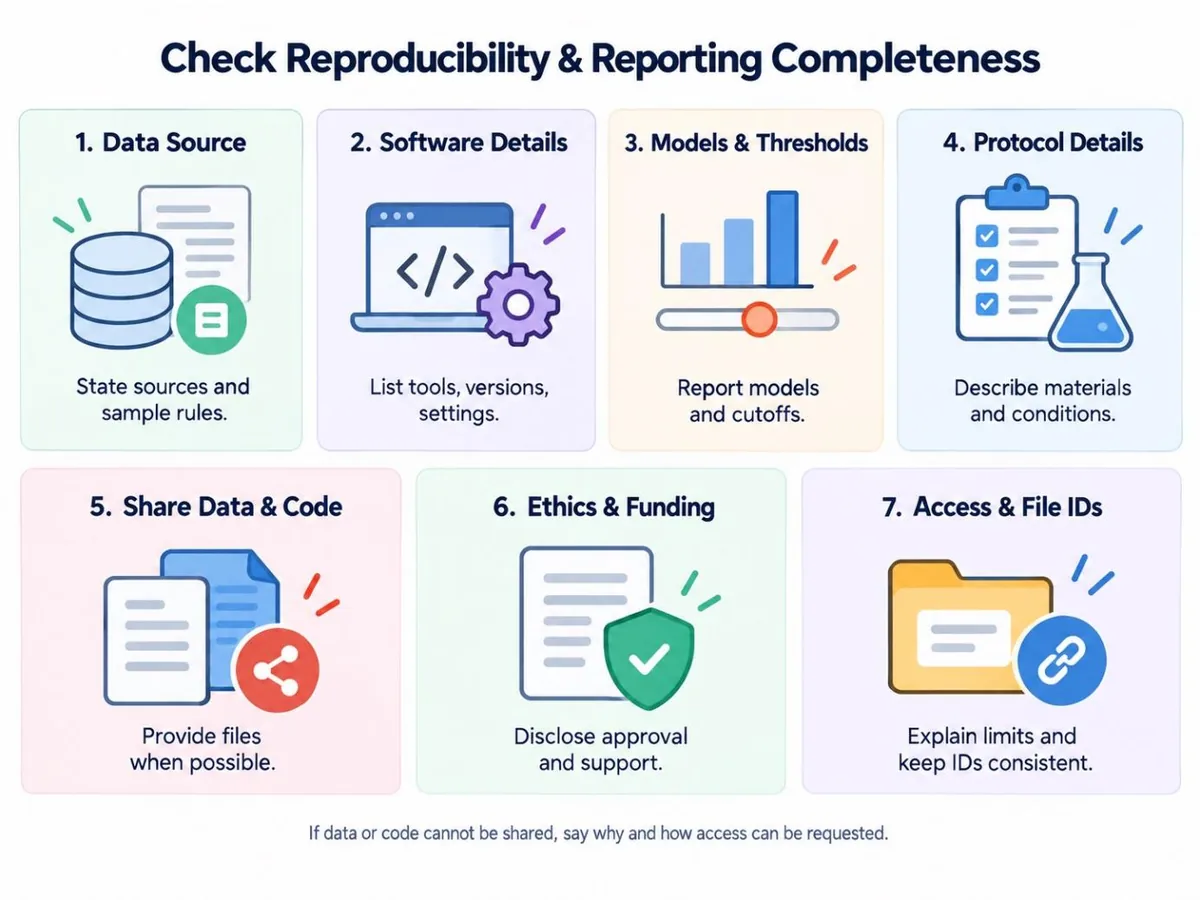
Before submission, review whether another researcher could follow the work and assess it independently.
Reproducibility depends on more than a detailed Methods section.
Check that the paper identifies:
- Data sources, sample definitions, and processing decisions
- Software, packages, versions, and important parameters
- Statistical models, thresholds, and correction methods
- Protocols, materials, and experimental conditions
- Data, code, or supplementary files that can be shared
- Ethical approval, consent, conflicts of interest, and funding
If data or code cannot be shared, explain why and state how qualified researchers may request access.
Make sure file names, dataset versions, accession numbers, and supplementary references are consistent throughout the manuscript.
Final Presentation and Submission Check
7. Perform a Final Presentation and Submission Check
Once the scientific logic is sound, complete the final presentation pass.
Confirm that the title and abstract accurately represent the paper and contain the terms readers are likely to use when searching for it.
Check the following details:
- The Abstract includes the objective, methods, key results, and conclusion.
- The keywords reflect the actual topic and methods.
- Every figure and table is cited in the text and has a clear caption.
- References are complete, current where appropriate, and formatted consistently.
- Acronyms are defined at first use.
- Supplementary files open correctly and match the main text.
- Author contributions, funding, ethics, data availability, and conflicts are included where required.
- The manuscript follows the target venue’s file, word-count, and formatting instructions.
Do not use formatting checks to hide unresolved scientific problems. A polished layout cannot compensate for an unsupported conclusion or an incomplete method.
How AI Can Support a Pre-Submission Review
AI can provide a useful second pass when it is used to identify questions, not to replace scientific judgment.
It can help locate:
- Unsupported claims
- Missing methodological details
- Inconsistent terminology
- Unclear links between evidence and conclusions
- Sections that need clearer explanations
- Potential reproducibility gaps
The researcher still needs to verify every finding against the original data, protocol, and study context.
AI feedback can be incomplete or wrong, especially when the paper contains specialized methods, complex figures, or information that is not included in the uploaded manuscript.
Use it to prioritize review, then make the final decision yourself.
For a structured check of methods, evidence, claims, and reproducibility, use PaperProof’s AI Manuscript Checker as a second set of eyes before submission.
Final Checklist
Before submitting, ask yourself:
- Can I state the research question and main contribution clearly?
- Does the study design support the conclusion I want to make?
- Are the samples, controls, procedures, and analysis methods sufficiently described?
- Does every major claim have appropriate evidence?
- Are uncertainty, limitations, and alternative explanations addressed?
- Do the numbers and labels agree across the text, figures, tables, and supplementary files?
- Could another researcher understand and repeat the work?
- Does the abstract accurately reflect the full paper?
- Have I completed the target venue’s reporting and formatting requirements?
- Have I reviewed the revised manuscript again after making changes?
If any answer is no, fix the highest-impact issue first.
A final pre-submission review is most valuable when it improves the logic and credibility of the paper, not only its appearance.
Frequently Asked Questions
What is the difference between reviewing and proofreading a research paper?
Proofreading focuses on grammar, spelling, formatting, and surface-level clarity.Reviewing a research paper examines the research question, study design, methods, evidence, analysis, conclusions, and reproducibility.A paper can be grammatically correct and still require substantial scientific revision.
When should I review my research paper before submission?
Review the paper after the main draft is complete and before final formatting.Review it again after making major changes. Leaving enough time between drafts can help you notice unclear assumptions and inconsistencies that are easy to miss while writing.
Can AI review a research paper before submission?
AI can help identify potential gaps and inconsistencies, but it cannot independently validate the underlying data or replace the author’s scientific judgment.Treat AI output as feedback to verify, not as a final decision about the quality or correctness of the research.
Conclusion
A strong pre-submission review checks whether the research question, study design, evidence, and conclusions all align. It also confirms that another researcher can understand the work, evaluate its reliability, and assess whether the findings support the claims.
Review the highest-impact issues first, then revise the manuscript and check it again before submission. A careful final review can improve the clarity, credibility, and reproducibility of the research.
PaperProof
Review Your Manuscript With More Confidence
Use PaperProof to identify gaps in methods, evidence, claims, and reproducibility, then organize revisions and review the manuscript again before submission.
Run a manuscript check