

Introduction
The Methods section explains how a study was designed, carried out, and analyzed. It gives readers the information they need to judge whether the research question was addressed appropriately and whether the findings can be trusted.
A methods section can look complete while still leaving important questions unanswered. It may name a statistical test without explaining why it was chosen, describe a sample without stating how participants were selected, or mention a protocol without identifying the changes made for the study. These gaps make it difficult to evaluate the evidence, reproduce the work, or understand the limits of the conclusions.
This guide explains how to evaluate the methods section of a research paper. Use it before submission, during peer review, or when deciding how much confidence to place in a study's findings.
What Makes a Methods Section Reliable?
Read the Methods section as an explanation of how the evidence was produced. The most useful questions are whether the design fits the research question, whether the sample and measurements are appropriate, and whether another researcher could understand the important decisions.
| Review area | What to check |
|---|---|
| Study design | Does the design support the question and the type of conclusion? |
| Participants or samples | Are the source, selection criteria, size, and characteristics clear? |
| Controls and allocation | Do the comparison groups address plausible alternatives? |
| Procedures and measurements | Could another researcher repeat the work and obtain the same type of data? |
| Analysis | Do the statistical or computational methods match the data and design? |
| Reporting | Are exclusions, missing data, ethics, and access to materials explained? |
A strong Methods section does not need to describe every routine action in equal detail. It needs to make the decisions that affect bias, interpretation, and replication visible to the reader.
How to Evaluate a Methods Section Step by Step
1. Match the Study Design to the Research Question
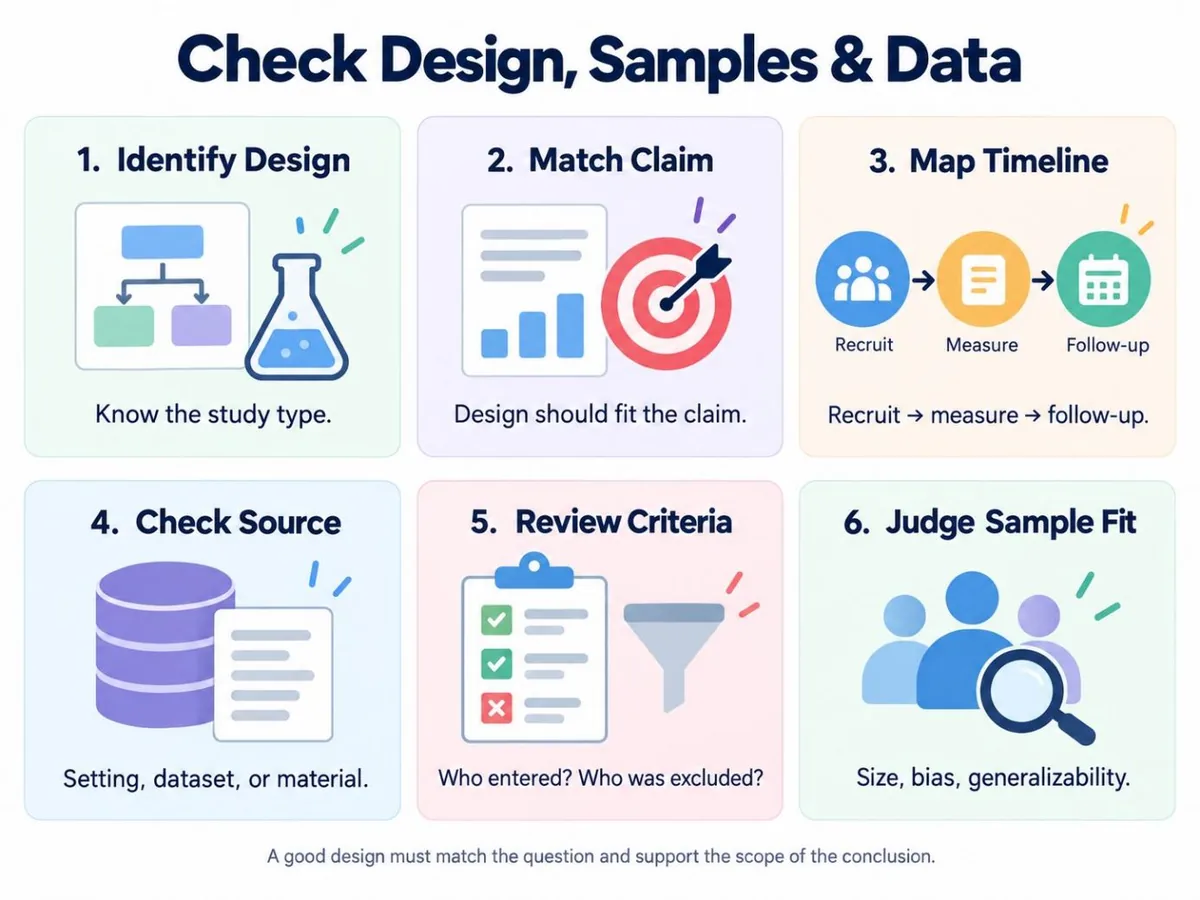
Start by identifying the design: observational, experimental, randomized, longitudinal, cross-sectional, diagnostic, qualitative, computational, or a validation study. Some papers combine several designs, so the role of each part should be clear.
Then compare the design with the claim. An observational study can identify associations, but it usually cannot establish causation without additional assumptions and analyses. A cross-sectional study describes relationships at one point in time, while a longitudinal design can address change over time. A laboratory experiment may support a mechanism under controlled conditions without showing that the same effect occurs in clinical practice.
Check whether the Methods explain the timing and sequence of recruitment, exposure or intervention, measurement, and follow-up. If the study includes several visits or stages, a clear timeline helps readers understand attrition and protocol changes.
2. Examine the Participants, Samples, and Data Sources
The paper should identify where the data came from and why the sample is appropriate for the research question. Look for the setting, recruitment period, source population, dataset, biological material, or computational input.
Review the inclusion and exclusion criteria. They should explain who or what could enter the study and which observations were removed. Pay attention to exclusions caused by missing measurements, protocol deviations, or quality thresholds. The authors should report how many cases were removed and whether excluded cases differed from those analyzed.
Check how the sample size was determined. A formal power calculation, precision target, available dataset, or qualitative stopping rule may be appropriate depending on the study. A large sample does not automatically make a study reliable, and a small sample does not make every result useless. The key question is whether the sample provides enough information for the stated objective and how its size affects uncertainty.
Finally, compare the sample with the population to which the authors generalize. A study may be internally consistent while still having limited external validity because of its setting, recruitment method, demographic composition, or eligibility criteria.
3. Review Controls, Comparators, and Allocation
Controls and comparison groups help distinguish the proposed explanation from background variation, measurement effects, and other plausible causes.
A negative control can reveal background or nonspecific effects. A positive control can show that the system is capable of producing an expected response. A placebo, sham procedure, baseline measurement, or matched comparison group can help separate an intervention effect from expectation, time, or selection effects.
Ask what each control is meant to test and whether it represents the relevant exposure or measurement process. A control that is poorly matched to the research question may provide little protection against bias.
For randomized studies, check the randomization unit, sequence generation, allocation concealment, and timing of assignment. If blocking, stratification, matching, or balancing was used, describe the variables and rationale. Also identify who knew the assignment or outcome status. If blinding was not possible, the paper should explain how the resulting risk of bias was reduced.
4. Check Whether the Procedures Are Reproducible
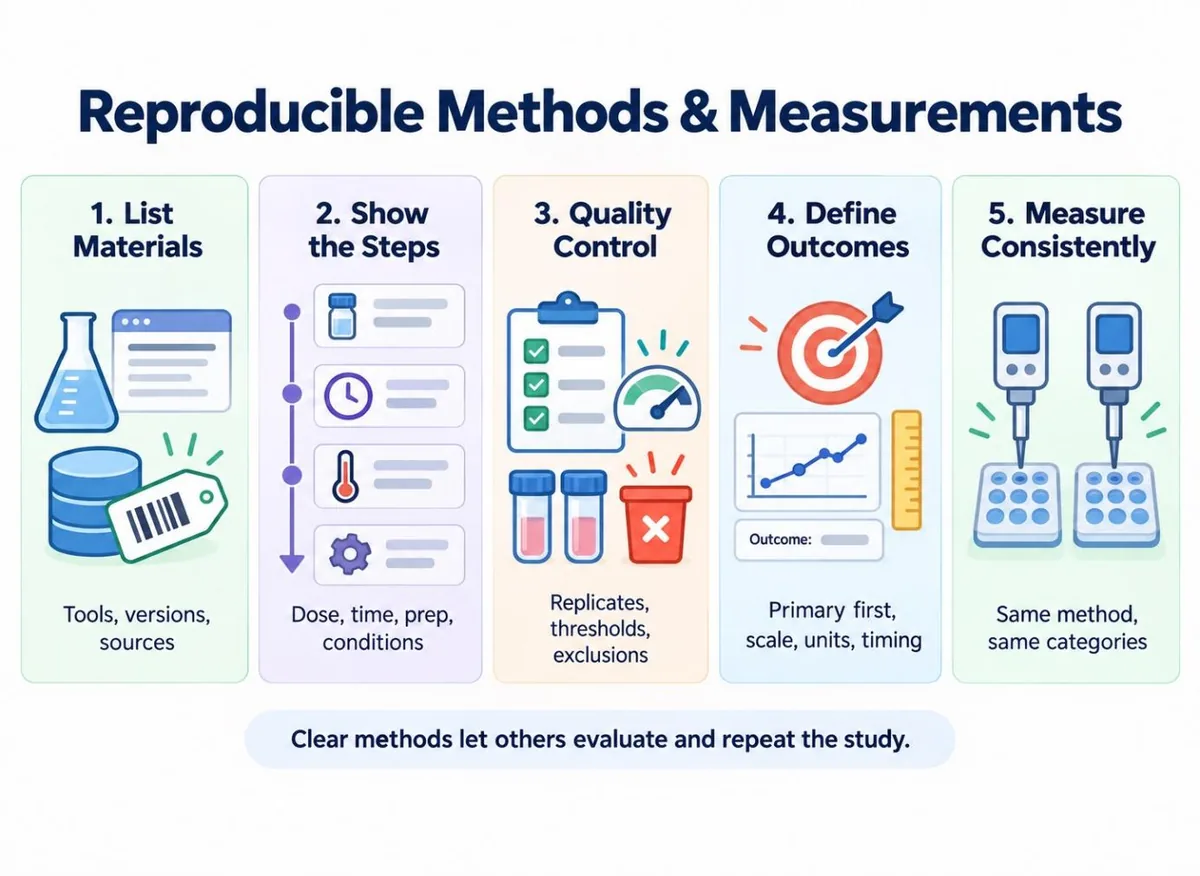
Another researcher should be able to understand what was done without guessing at important details. Check the materials, instruments, reagents, devices, software, databases, and versions used. Include manufacturer details or catalog numbers when they affect replication.
Review the procedure in sequence. Details such as dose, duration, temperature, timing, storage conditions, preparation, stopping rules, and preprocessing may affect the result. If the study follows a published protocol, the authors should describe meaningful modifications instead of citing the protocol without explanation.
Look for quality-control procedures. The Methods should state how calibration, duplicate measurements, technical or biological replicates, failed runs, repeat measurements, and quality thresholds were handled. If observations were discarded, report the rule and the number affected.
For qualitative research, review interviewer training, coding procedures, reflexivity, saturation or stopping criteria, and how disagreements were resolved. Reproducibility does not mean every study must use the same approach. It means the approach is documented well enough to evaluate.
5. Evaluate the Outcomes and Measurements
The Methods should define what was measured and how each variable became an analysis-ready value. Identify the primary outcome before the secondary or exploratory outcomes. Check the measurement scale, units, timing, direction, and meaningful threshold where relevant.
Ask whether the measurement captures the concept the paper claims to study. A proxy can be useful, but the authors should explain its relationship to the target outcome and acknowledge its limitations.
Check whether the same measurement method was used across groups and time points. Differences in instruments, assessors, laboratory batches, or preprocessing can create apparent effects unrelated to the research question.
The paper should also state how variables were normalized, categorized, scaled, imputed, or transformed. Thresholds and reference categories should be defined. If an outcome or analysis was changed after data collection, explain the reason and label the result appropriately.
6. Assess the Statistical or Computational Analysis
The analysis should match the design, data type, and objective. Review the outcome type, predictors, repeated measurements, clustering, censoring, time-to-event structure, and dependence among observations. Ask whether the chosen test or model accounts for these features.
For computational analyses, check the algorithm, preprocessing order, feature construction, training and validation strategy, and evaluation metrics. When the goal is to estimate performance on new data, the evaluation data should not also be used to fit or tune the model.
Review assumptions and diagnostics. Depending on the analysis, these may include distributional assumptions, linearity, proportional hazards, independence, collinearity, class balance, convergence, or calibration. If an assumption was not met, explain the response, such as a transformation, robust method, alternative model, sensitivity analysis, or more cautious interpretation.
If the study tests many outcomes, predictors, subgroups, or time points, check how it addressed multiple comparisons. Exploratory analyses should be identified as exploratory. The paper should also describe model selection, variable entry, hyperparameter tuning, and whether the analysis was prespecified.
P-values alone do not show the magnitude or practical importance of a finding. The analysis should support effect sizes with confidence or credible intervals where appropriate, together with the number of observations used for each result.
For a structured check of study design, methods, controls, and analysis, use PaperProof's AI Manuscript Checker as a second set of eyes before submission.
7. Review Missing Data, Exclusions, and Deviations
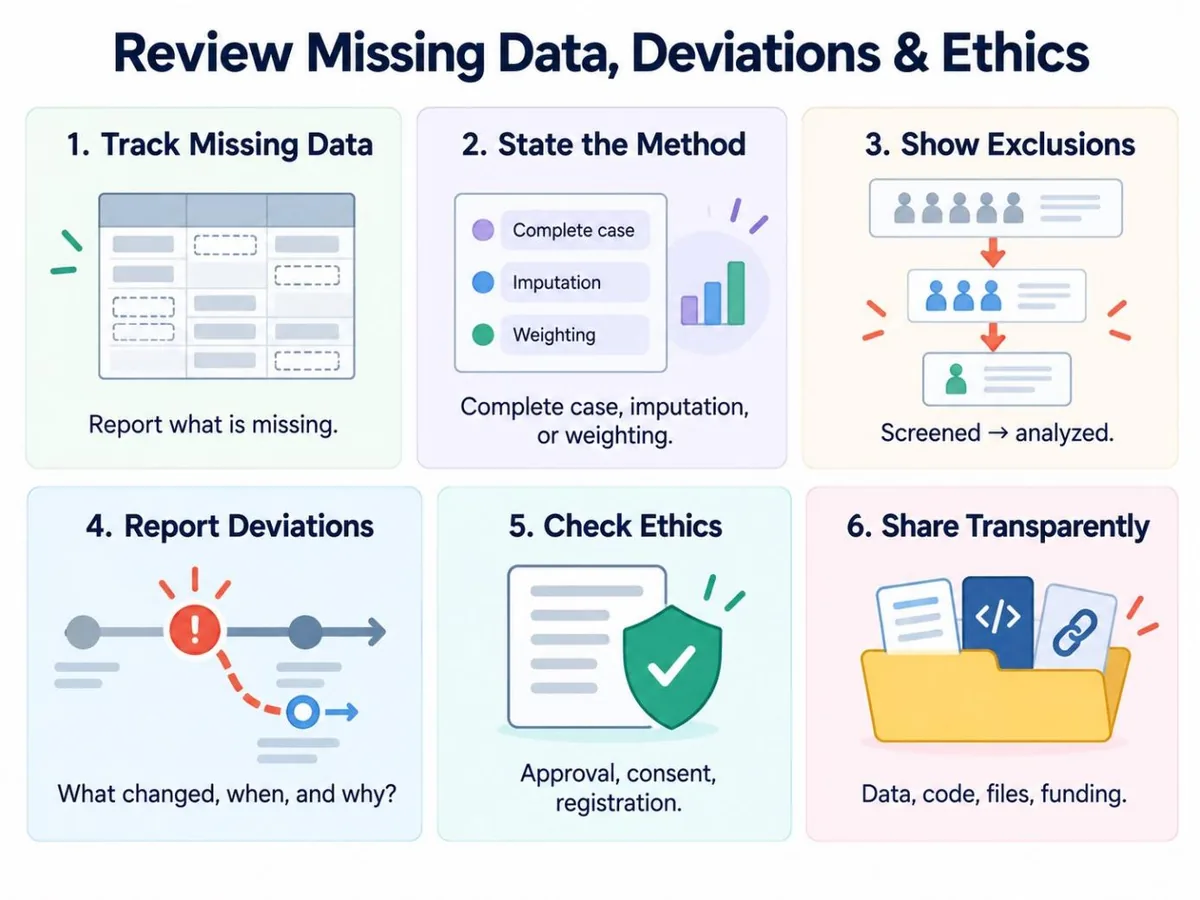
Missing values and protocol deviations can change the study population and the estimated result. Report how much data were missing for each important variable and whether missingness differed across groups or time points.
State whether the analysis used complete cases, imputation, weighting, a likelihood-based method, or another approach. If the result depends on an assumption about missingness, describe that assumption and include a sensitivity analysis when feasible.
For clinical, longitudinal, or survey studies, show how many participants were screened, enrolled, assigned, followed, and analyzed. For experiments and computational datasets, report how many samples or records were removed at each quality-control step.
If the protocol, endpoint, sample, or analysis changed, describe the change, timing, reason, and likely effect. Transparent reporting helps readers distinguish a prespecified decision from a response to the observed data.
8. Check Ethics and Reporting Completeness
The Methods should identify ethics approval or exemption, informed consent, trial or protocol registration where relevant, data protection, funding, conflicts of interest, and author contributions when required.
Check whether data, code, materials, and supplementary files are available. If they cannot be shared, explain the restriction and state how qualified researchers may request access. File names, dataset versions, accession numbers, and supplementary references should remain consistent throughout the paper.
Finally, compare the Methods with the Abstract, Results, figures, and Discussion. Every major result should have a corresponding method, and the conclusion should not depend on an analysis that the paper never explains.
Common Methods Section Mistakes
Naming a Method Without Explaining It
Listing a statistical test, software package, or published protocol is not enough when readers need to understand the decision or reproduce the work. Explain the relevant settings, assumptions, and modifications.
Hiding Selection Decisions
Unclear recruitment, exclusions, outcome definitions, or missing-data handling can change the study population. Report these decisions and their effect on the analysis.
Treating Statistical Significance as Study Quality
A small P-value does not prove that the design was appropriate, the effect is important, or the result will generalize. Evaluate the method, estimate, uncertainty, and limitations together.
Mixing Planned and Exploratory Analyses
Analyses added after reviewing the data should be labeled exploratory. Presenting them as prespecified can make the evidence appear stronger than it is.
Overstating Reproducibility
A paper can be detailed and still omit the files, versions, parameters, or decisions needed to repeat the work. Check the supporting materials rather than assuming that a long Methods section is complete.
Frequently Asked Questions
What makes a Methods section strong?
A strong Methods section explains the design, sample, procedures, measurements, analysis, and reporting decisions clearly enough for readers to evaluate the evidence and understand how the work could be repeated.
How detailed should the Methods section be?
Include every detail that could affect interpretation or replication. Use supplementary files or a linked protocol for extensive operational details, but keep the main paper clear about the decisions that define the study and its analysis.
Can a study be reliable if its Methods section is incomplete?
The underlying work may be sound, but an incomplete Methods section prevents readers from evaluating it fully. Missing details should be treated as a reporting limitation, especially when they affect bias, measurement validity, or reproducibility.
Should exploratory analyses be included?
Yes. Describe exploratory analyses and label them as such. Readers need to know which analyses were planned in advance and which were added after examining the data.
Conclusion
Evaluating a Methods section means checking whether the study design, sample, procedures, measurements, and analysis support the conclusions that follow. The goal is to understand how the evidence was produced and which uncertainties remain.
Review the highest-impact decisions first, then compare the Methods with the Results and Discussion. A transparent, reproducible Methods section makes a paper easier to evaluate, reproduce, and trust.
PaperProof
Evaluate Your Methods With More Confidence
Use PaperProof to identify missing methodological details, assess evidence and analysis choices, and organize revisions before submission.
Check your methods