

Introduction
To revise an overstated claim, identify exactly what the evidence establishes, remove the unsupported extension, and make the revised scope explicit. Replacing “proves” with “suggests” is rarely enough when the underlying problem concerns an unmeasured outcome or an unjustified causal explanation.
Overstatement can enter a paper during drafting, revision, or efforts to explain its significance. A local finding becomes a general rule, an association becomes an intervention effect, or a promising model becomes ready for clinical use.
This guide shows how to revise overstated claims in a research paper using concrete examples. The aim is to preserve the supported contribution while correcting the part of the statement that exceeds the study’s evidence.
What Counts as an Overstated Claim
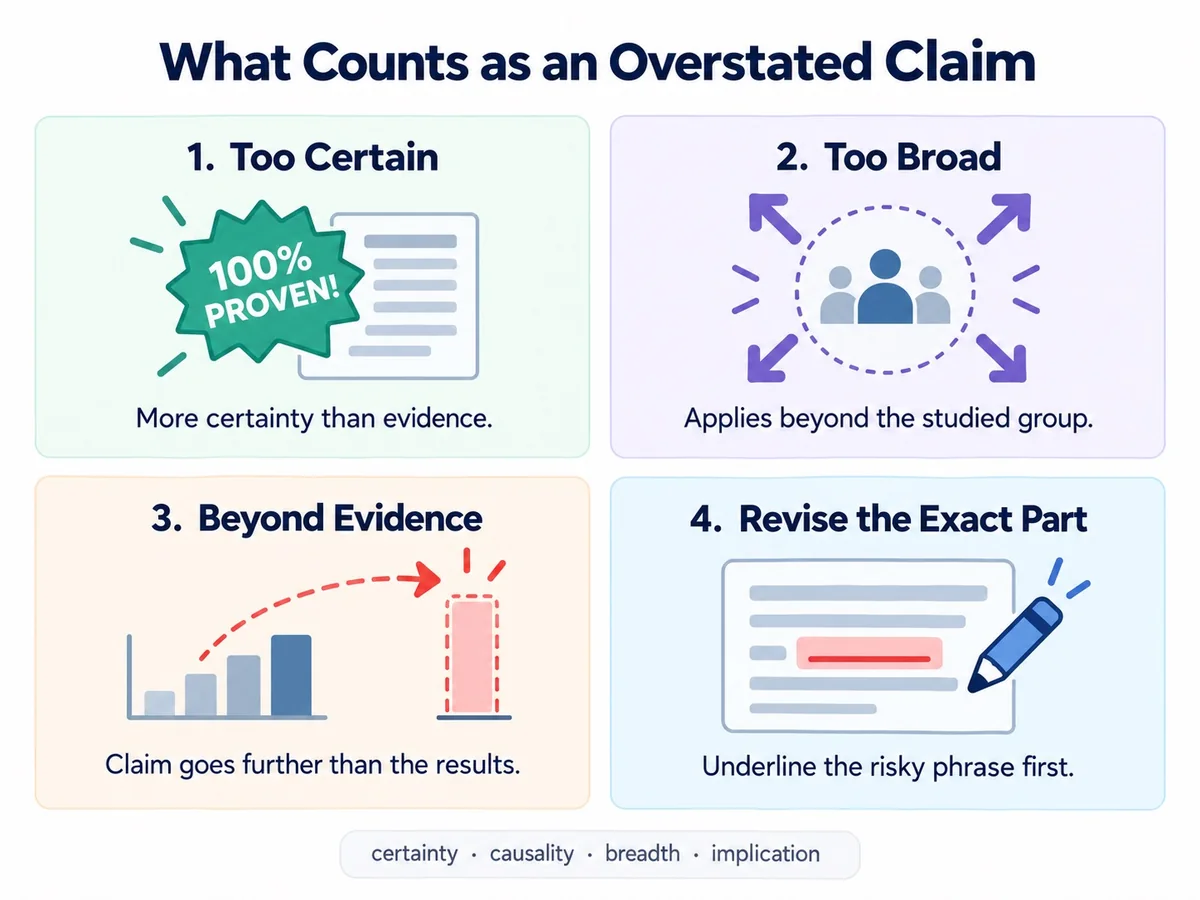
A claim is overstated when its certainty, causal meaning, breadth, or practical implication goes beyond what the design and results justify. The problem is the relationship between the statement and the evidence, rather than a forbidden list of words.
Terms such as “demonstrates,” “effective,” or “safe” can be appropriate in a clearly defined context with sufficient evidence. They become problematic when the paper leaves the relevant population, outcome, comparison, or uncertainty unstated.
Before changing a sentence, underline the part readers could reasonably interpret too broadly. That might be the causal verb, the population label, the asserted mechanism, or the recommendation. This identifies the decision the revision needs to make.
Decide Whether the Fix Needs Wording or Evidence
First locate the result behind the claim. Write a plain account of the study design, what was measured, the main estimate or finding, and its important limitations. Use that account as the boundary for the revision.
If the result supports a narrower statement, revise the wording to express that statement. If relevant evidence already exists but was poorly reported, make the supporting result and its limitations visible. If the argument needs a new analysis, decide whether the data and design can support a justified analysis, and report whether it was planned or exploratory.
Sometimes the required evidence does not exist. A sentence edit cannot establish a mechanism, create independent validation, or supply long-term follow-up. Remove the unsupported assertion or describe it as a question for further study, without implying that cautious wording makes it a finding.
The examples below are hypothetical. Each revision assumes that the narrower statement accurately reflects the study’s actual results.
Five Examples of Revising Overstated Claims
1. Replace an Unsupported Causal Claim
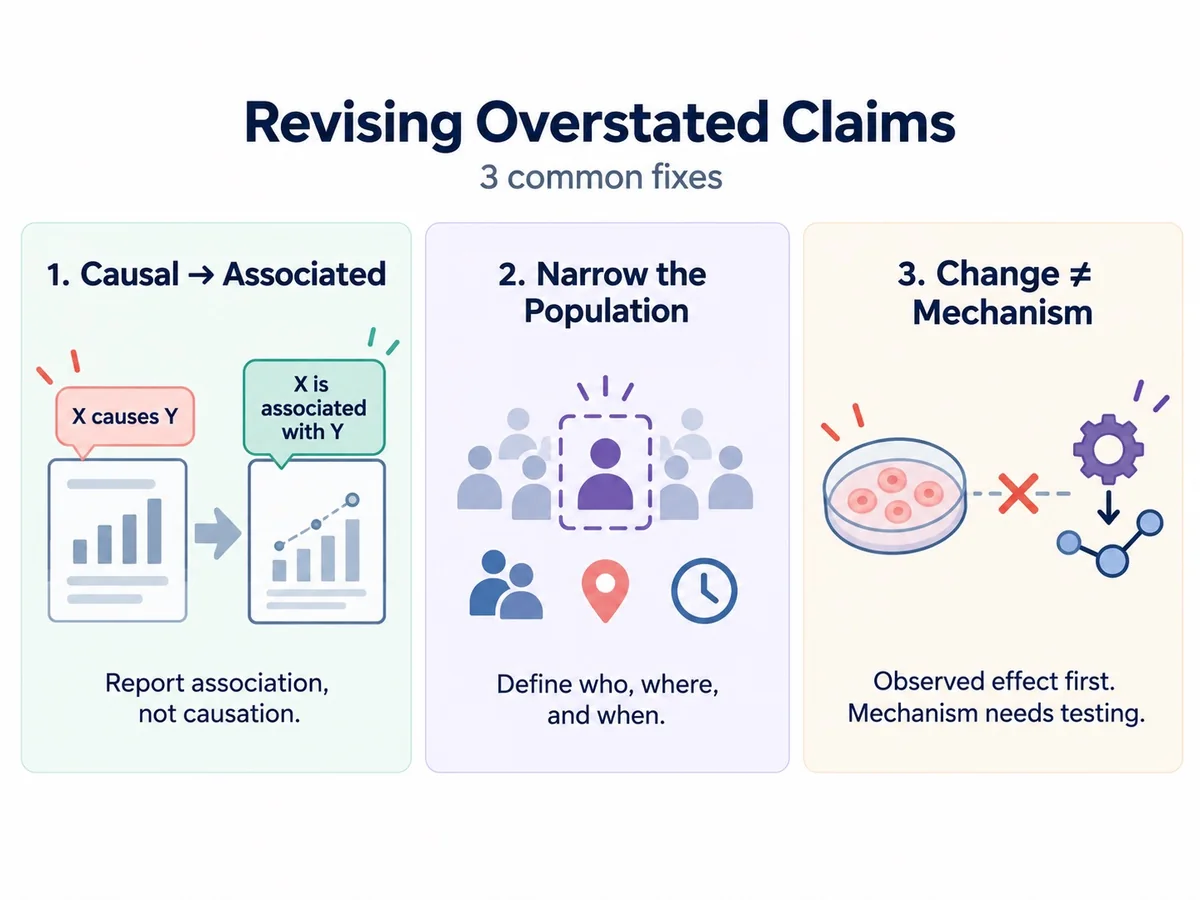
Original: “Higher intake of nutrient X reduces disease risk.”
Suppose the study is an observational cohort analysis. The sentence implies that changing intake would change risk, while differences in other behaviors or health characteristics could contribute to the association.
Revised: “Higher reported intake of nutrient X was associated with lower disease incidence during follow-up in this cohort. Residual confounding may contribute to the association.”
This revision identifies the measured exposure, outcome, and population while removing the unsupported intervention claim. Keep adjustment variables and relevant sensitivity analyses visible elsewhere in the paper. If the study uses a causal inference approach, evaluate its assumptions and limitations before deciding whether causal language is justified.
2. Narrow a Claim About the Population
Original: “The intervention improves recovery in patients with stroke.”
Suppose a randomized trial enrolled only adults with mild stroke at one specialist center and assessed recovery after six weeks. The original sentence leaves readers to assume broader eligibility and duration than were studied.
Revised: “Among adults with mild stroke enrolled at this center, the intervention improved the measured recovery outcome at six weeks compared with usual care.”
Use “improved” only if the design, estimate, and uncertainty justify it, and name the outcome precisely in the manuscript. The revision defines the population, comparator, and time point. It does not establish effectiveness for severe stroke, other settings, or longer follow-up.
3. Separate a Measured Change From a Proposed Mechanism
Original: “Compound A suppresses tumor growth by blocking pathway B.”
Suppose the experiments show reduced cell proliferation alongside lower expression of a pathway marker, without directly testing whether the pathway mediates the effect. The original wording turns coincident observations into an established mechanism and broadens a cell-based endpoint into tumor growth.
Revised: “Cells treated with compound A showed reduced proliferation and lower expression of a pathway B marker. Whether pathway B mediates the proliferation effect remains to be established.”
The revision reports both observations without asserting the untested link. A mechanistic explanation may require additional perturbation, rescue, or other suitable experiments. Select those experiments according to the scientific question; adding a generic limitation cannot replace them.
4. Remove a Premature Clinical Recommendation
Original: “The diagnostic model is ready for routine clinical use.”
Suppose the model was developed and internally evaluated using a retrospective dataset. Good discrimination in that setting does not establish how the model will perform in new populations or affect clinical decisions.
Revised: “The model showed promising discrimination in this retrospective dataset. Independent validation and evaluation in the intended clinical setting are needed before its suitability for routine use can be assessed.”
Report the actual performance measures and uncertainty in the Results. Depending on intended use, further evaluation may need to address calibration, workflow, clinical benefit, and harms. “Promising” should also be removed if the reported results do not support that assessment.
5. Revise a Claim of No Effect
Original: “Treatment A and treatment B are equally effective.”
Suppose a conventional superiority analysis found no statistically significant difference, with an interval that still allows clinically meaningful differences. The result does not establish equivalence.
Revised: “The study did not detect a statistically significant difference between treatments. The confidence interval included differences that could be clinically important, so the findings do not establish equivalence.”
Add the estimate and interval where the result is reported. If equivalence is the intended question, a suitable design, prespecified justified margins, and an appropriate analysis are needed. A nonsignificant p-value cannot supply those elements after the fact.
Check the Revised Claim Across the Manuscript
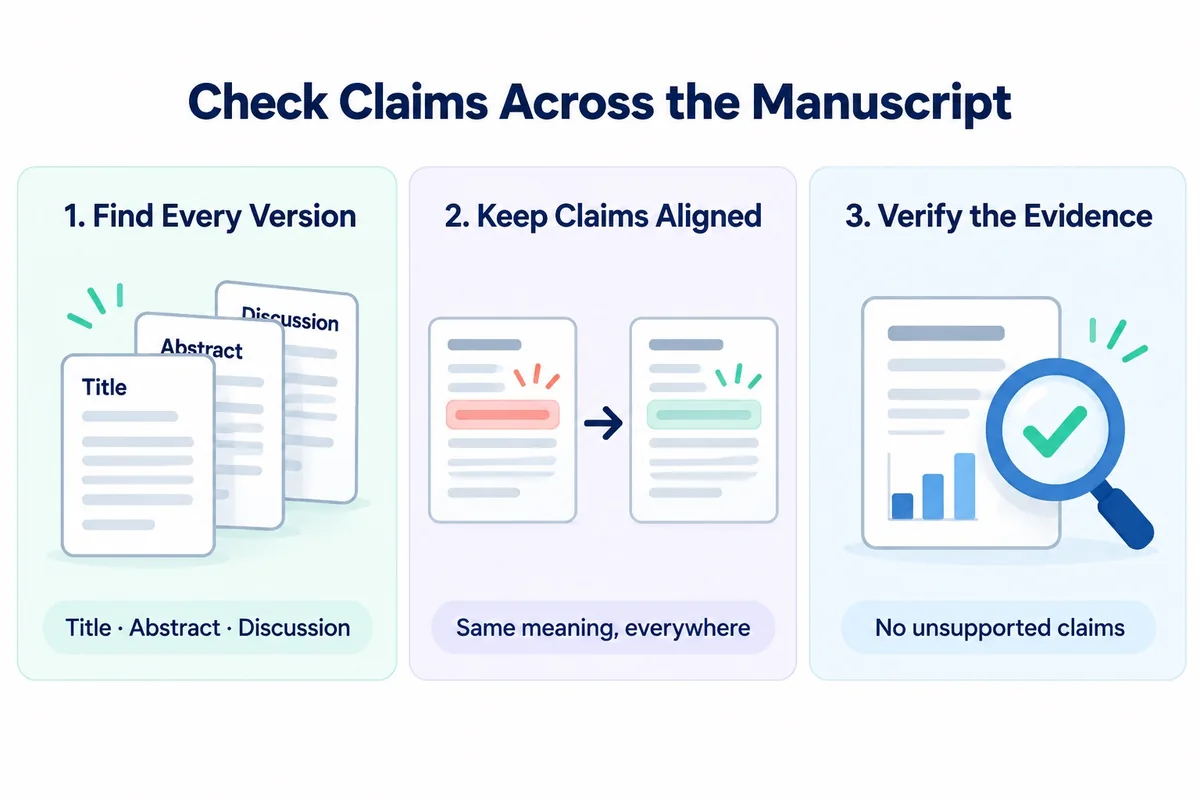
After fixing the main sentence, search for versions of the same claim in the title, Abstract, final Introduction paragraph, figure legends, Discussion, and Conclusion. A cautious Discussion cannot correct an Abstract that still presents the stronger claim.
Keep the scientific meaning consistent across these locations while respecting their different roles. Check population labels, outcome names, causal verbs, time frames, and recommendations. If a revised claim depends on a limitation, make that limitation visible wherever its omission would mislead readers.
PaperProof’s Revision Assistant can help you understand a flagged concern and consider suggested wording where available. You decide which changes to make in your own editor. After uploading a revised version, compare the findings across review rounds and check whether the underlying issue has been addressed.
Before accepting a revision, confirm that it preserves the supported result, removes the unsupported inference, and introduces no new evidence claim. If the sentence now depends on an analysis or experiment that was never performed, revise it again.
Frequently Asked Questions
Is Adding May or Suggests Enough?
Only when the remaining statement is a defensible interpretation. “May improve survival” is still misleading if the study measured only a laboratory marker and provides no adequate basis for a survival claim. Revise the outcome or remove the assertion when necessary.
Will More Cautious Language Weaken the Paper?
Precision helps readers identify the actual contribution. Keep clear statements of well-supported findings and narrow only what exceeds the evidence. Excessive hedging can obscure a reliable result just as overconfidence can misrepresent it.
What If Feedback Asks for Evidence I Cannot Provide?
Assess whether existing data can address the concern. If they cannot, explain the limitation, narrow or remove the claim, and state what remains unresolved. When responding to formal feedback, describe the change and its location without implying that new work was completed.
Conclusion
An effective claim revision changes the scientific meaning where necessary, rather than adding caution to an otherwise unsupported statement. Define what the evidence establishes, correct the causal meaning or scope, and distinguish findings from untested explanations and applications.
Then check the claim everywhere it appears. A consistent, evidence-based account of the contribution gives readers a clearer reason to trust and build on the work.
PaperProof
Revise Claims With the Evidence in View
Use PaperProof to help interpret feedback and consider revision suggestions, then verify that the changes you make address the scientific concern.
Revise with evidence