

Introduction
A research paper’s Introduction should help readers understand the problem, the uncertainty that remains, and the question the study addresses. To evaluate it, check whether those elements form a clear argument supported by relevant literature.
An Introduction can contain many citations and still leave the purpose unclear. It may describe a broad topic without identifying a specific gap, claim novelty without a fair comparison, or promise an answer that the study was not designed to provide.
This guide explains how to evaluate the introduction of a research paper before submission. The aim is to assess its scientific logic and focus, so readers can see why the study was needed and what it set out to establish.
What a Strong Introduction Needs to Establish
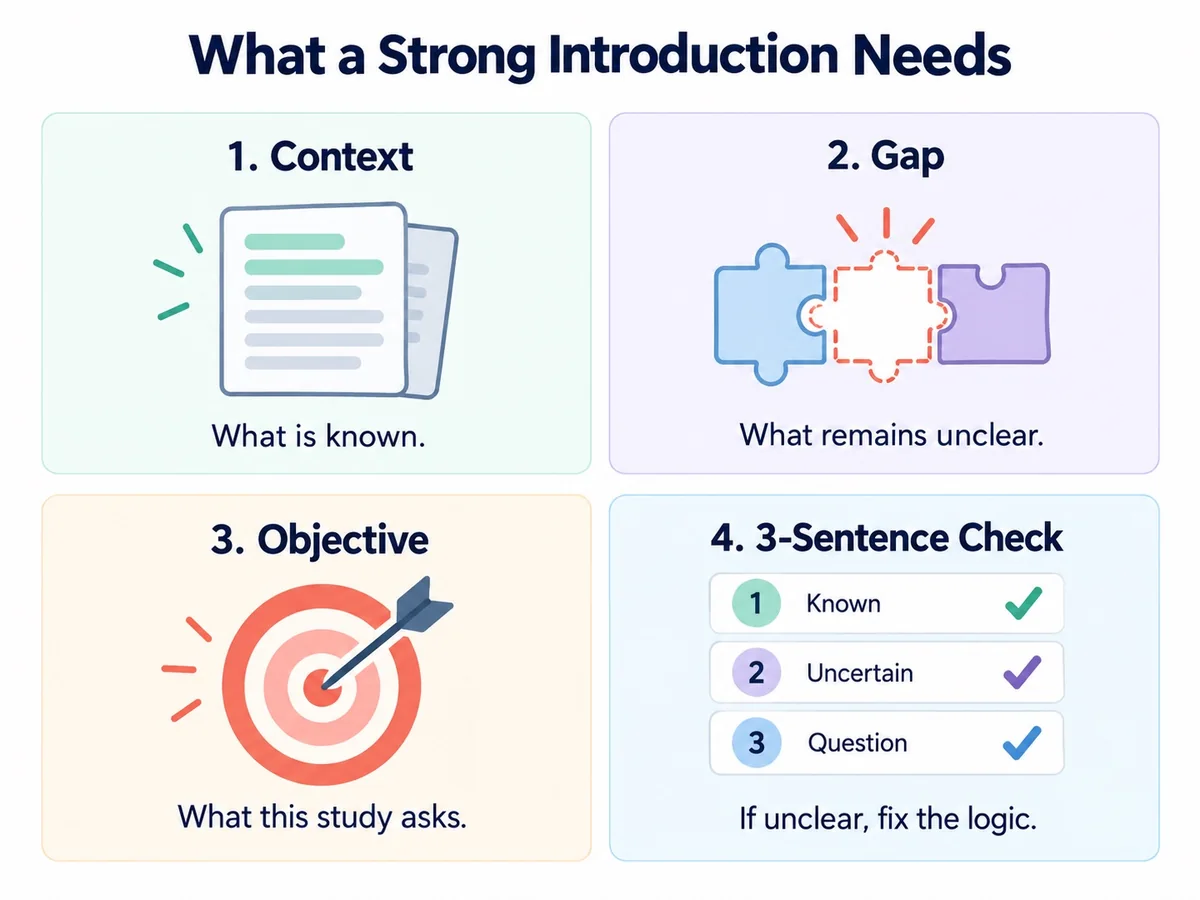
A useful Introduction moves from necessary context to a specific unresolved issue, then connects that issue to the study’s objective. The exact structure varies by field and article type, but readers should be able to explain why this particular question follows from the literature presented.
The research gap is central to that connection. It may be an uncertain mechanism, conflicting findings, an inadequately tested method, a missing population, or a limitation in how an outcome has been measured. Simply stating that few studies exist does not explain why another study matters.
Read the Introduction once without editing. Write its argument in three sentences: what is known, what remains uncertain, and what this study asks. If that summary requires guessing, locate the missing connection before polishing individual sentences.
How to Evaluate an Introduction Step by Step
1. Check Whether the Background Leads to the Actual Problem
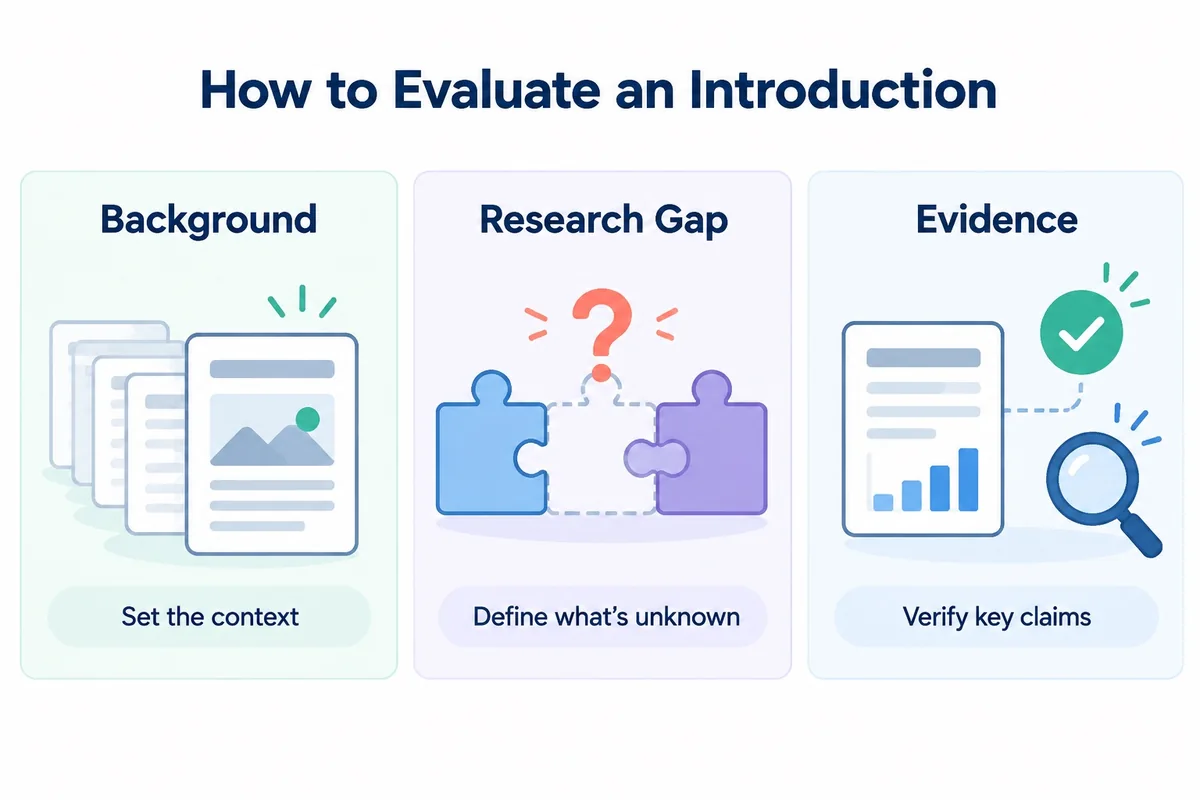
The opening should give readers the context needed to understand the study. Evaluate each background paragraph by asking what it contributes to the eventual research question.
Broad statements about global importance may be relevant, but they should lead to the specific problem quickly. A study of a measurement method, for example, needs to explain the measurement problem rather than spending most of its opening describing the disease in general.
Check that essential concepts are defined and the level of detail fits the journal’s readership. Remove material that is interesting but has no role in the argument. Add context when a specialist assumption would otherwise prevent readers from understanding the gap.
2. Test Whether the Research Gap Is Specific and Justified
Find the sentence that states what remains unknown or unresolved. Can you identify the variable, population, method, relationship, or condition involved? “More research is needed” leaves the reader without a testable problem.
Next, inspect the reasoning behind the gap. If earlier findings conflict, explain the relevant disagreement. If a method has limitations, identify which limitation affects the proposed use. If a population is missing, explain why results from existing populations may not transfer.
Be cautious with claims that no previous study exists. A defensible gap requires a sufficiently careful literature search and a clearly bounded claim. Do not turn unfamiliarity with a paper into a claim of complete novelty.
3. Check Whether Citations Support the Statements Beside Them
Review the sources behind the central background claims and the gap statement. Ask whether each cited study supports the precise statement, including its population, outcome, design, and level of certainty.
A review can provide an overview, while a claim about a particular experiment or dataset may require checking the original study. Recent publications can update the context, but older foundational work may still be essential. Citation quality depends on relevance and accuracy rather than a fixed publication window.
Look for selective presentation. If credible evidence challenges the paper’s rationale, acknowledge it and explain why uncertainty remains. A persuasive Introduction gives readers a fair account of the problem rather than building its case by omitting inconvenient findings.
4. Match the Objective to the Gap and Study Design
The final part of the Introduction should state what the study aims to determine, compare, estimate, describe, or explore. Check whether that objective directly addresses the gap established earlier.
Make the scope visible. Depending on the study, this may mean identifying the population or system, exposure or intervention, comparator, outcome, and setting. Not every objective needs every element, but the central question should be understandable without reading the entire Methods section.
Then check the verb against the design. An observational comparison framed as a test of whether an exposure “causes” an outcome may promise more than the analysis can establish. A study estimating diagnostic accuracy should not be introduced as demonstrating improved patient outcomes unless it evaluates those outcomes.
5. Evaluate the Hypothesis and Claimed Contribution
Where a hypothesis is appropriate, check that it is specific and connected to the rationale. Distinguish a prespecified hypothesis from an explanation developed after seeing the results. Exploratory, descriptive, and qualitative studies do not always need a directional hypothesis.
The contribution should explain what knowledge the study can add. “This is the first study” is not enough on its own, even when accurate. Readers also need to understand why the new comparison, population, method, or explanation is useful.
Compare the promised contribution with the actual work. If the Introduction promises a broadly applicable tool but the study evaluates a prototype in one dataset, narrow the promise. The objective, design, and eventual interpretation should describe the same study.
6. Review Paragraph Order and Scientific Focus
Give each paragraph a short functional label, such as necessary background, established evidence, unresolved issue, or study objective. Read those labels in sequence to see whether the argument progresses.
Watch for repeated gap statements, abrupt changes of topic, long lists of studies, and methods details that interrupt the rationale. Group previous findings by the question they answer rather than listing publications one by one.
Journal conventions determine whether an Introduction briefly previews findings. If it does, keep the preview accurate and concise. The section should still establish the rationale rather than repeat the Abstract or Discussion.
PaperProof’s AI Manuscript Checker can help identify potential gaps in the research question, contribution, and manuscript logic. Use its feedback to guide your review, and verify literature claims against the original sources yourself.
A Worked Example of a Clearer Research Rationale
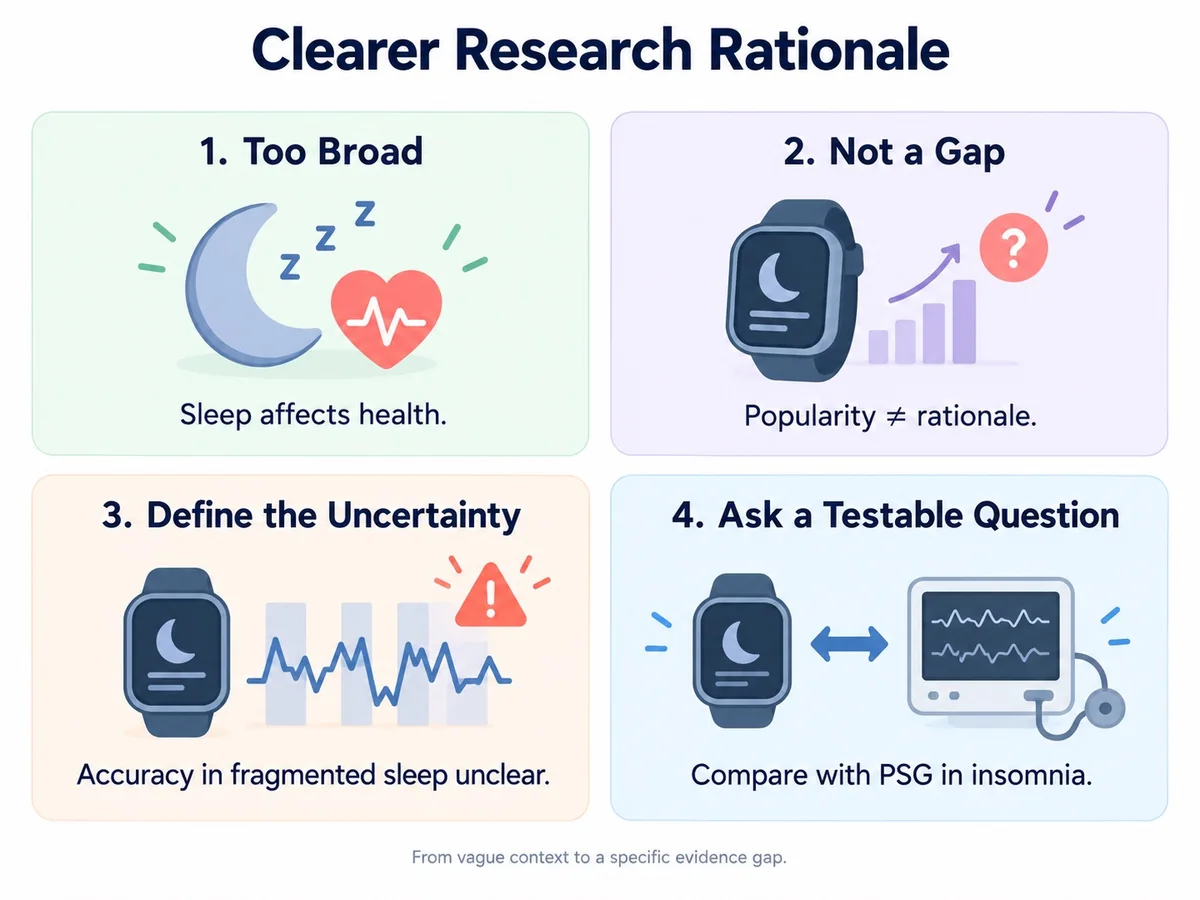
Consider this hypothetical argument: “Sleep affects health. Wearable devices are increasingly popular. Few studies have examined wearable devices. We therefore studied a sleep sensor.”
The statements do not yet explain the problem the sensor is meant to solve. Popularity does not establish an evidence gap, and the objective leaves the evaluation unclear.
A more focused rationale would identify the measurement uncertainty: “The sensor’s accuracy during fragmented sleep remains uncertain because previous evaluations focused on healthy adults. We compared its sleep estimates with polysomnography in adults with insomnia.”
That version connects a defined limitation to a specific evaluation. It is appropriate only if the cited literature supports the stated gap and the study actually uses that population and comparator. Clearer wording must remain faithful to the evidence.
Final Introduction Checklist
Before submission, ask whether:
- The opening supplies context needed for the specific question.
- The gap states what remains uncertain and why it matters.
- Citations support the claims made beside them.
- Relevant conflicting evidence is represented fairly.
- The objective follows from the gap and fits the design.
- The contribution describes what this study can establish.
- Each paragraph advances the rationale without unnecessary repetition.
Read the Introduction beside the Methods and Conclusion once more. A well-focused opening should prepare readers for the study they actually encounter.
Frequently Asked Questions
How Long Should a Research Paper Introduction Be?
Follow the target journal’s guidance and the needs of the article type. Include enough context to establish the problem, gap, and objective. Extra length is useful only when it helps readers understand that argument.
Does Every Introduction Need a Hypothesis?
No. A hypothesis may suit confirmatory research, while exploratory, descriptive, methodological, or qualitative work may be better framed around objectives or research questions. State the purpose honestly and follow disciplinary conventions.
What Is the Difference Between a Research Gap and an Objective?
The gap identifies unresolved knowledge or a limitation in existing evidence. The objective states what the current study will do to address it. Readers should be able to connect the objective directly to the gap.
Conclusion
Evaluating an Introduction means checking whether the literature, gap, and objective form a defensible rationale. A clear opening gives readers enough context to understand the question and sets expectations the study can meet.
Start with that logic, then refine paragraph order and wording. An accurate, focused contribution gives the paper a stronger foundation than an unsupported claim of novelty.
PaperProof
Make Your Research Question Easier to Evaluate
Use PaperProof to help identify unclear questions, gaps in the rationale, and contribution claims that need attention before submission.
Evaluate your introduction