

Introduction
A research conclusion is supported when the reported evidence justifies what the paper says happened, how confidently it says it, and where the finding applies. A statistically significant result alone cannot establish all three.
The mismatch is often subtle. An association becomes a causal explanation, a laboratory result becomes a clinical recommendation, or a finding from one sample becomes a statement about an entire population. The result may be useful even when the conclusion is too broad.
This guide explains how to check whether research conclusions are supported by evidence before submission. It focuses on the connection between results and interpretation, so you can identify which conclusions are defensible and which need more evidence or a narrower scope.
What Makes a Conclusion Supported by Evidence
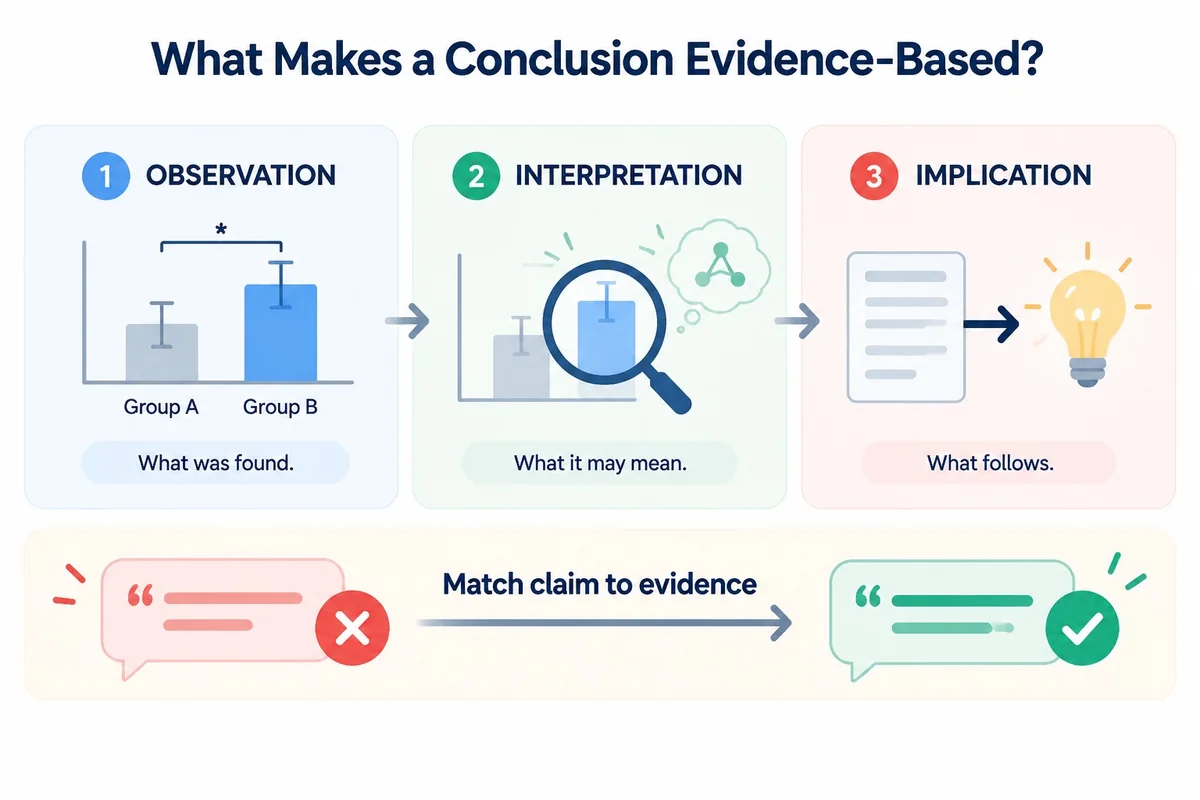
Start by separating three levels of statement. An observation reports a finding, such as a difference between groups. An interpretation explains what that finding may mean. An implication proposes what could follow for theory, practice, or future research.
Each level requires its own justification. A difference in a measured biomarker does not automatically establish a biological mechanism, and a plausible mechanism does not establish a treatment benefit. Check the evidence needed for the particular statement rather than treating every positive result as support for the whole argument.
A conclusion can also be appropriately cautious and still unsupported. Adding “may” does not fix a claim about an outcome the study never measured. The question is whether the inferential step is reasonable and visible to the reader.
How to Check Conclusions Against the Evidence
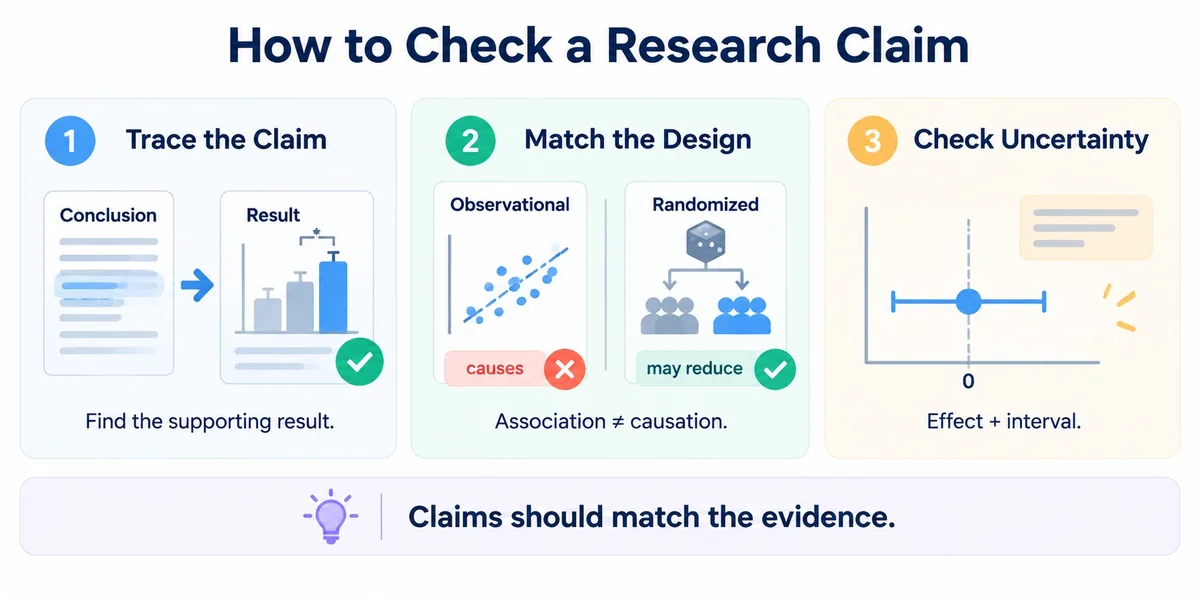
1. Trace Each Main Claim to a Specific Result
Highlight the main conclusions in the Abstract and Discussion. For each, locate the exact result, figure, table, or qualitative finding that supports it. Record what was measured, the comparison, and the direction of the finding.
Then ask whether the evidence is direct. A paper claiming improved patient outcomes needs evidence about patient outcomes; performance on a laboratory measure may support only a narrower claim. In qualitative work, interpretations should be traceable to the reported data and analysis, with attention to accounts that complicate the main theme.
If you cannot identify the supporting result, check whether the statement belongs to the study’s findings, earlier literature, or a hypothesis for future work. Label those roles clearly.
2. Match the Type of Claim to the Study Design
Identify whether the conclusion is descriptive, associative, predictive, or causal. These are different claims even when they use the same variables.
An observational association does not by itself show that changing the exposure would change the outcome. Causal inference requires a defensible design, assumptions, and analysis that address relevant alternative explanations. Randomization can strengthen causal inference, but missing outcomes, nonadherence, and the analysis used still matter.
Prediction also needs its own evidence. A model that fits the development dataset well has not necessarily demonstrated performance on new data. Check whether the validation setting matches the setting described in the conclusion.
3. Examine Magnitude and Uncertainty Together
Read the effect estimate with its confidence or credible interval, sample size, and measurement scale. Ask whether the estimated difference is meaningful for the research question and how much uncertainty remains.
A small p-value does not establish practical importance. A nonsignificant result does not establish no effect, especially when the interval still includes effects that would matter. Claims of equivalence or noninferiority need suitable designs, justified margins, and analyses.
Check whether the paper emphasizes a favorable point estimate while overlooking a wide interval or unstable subgroup estimate. The conclusion should reflect the information in the full result.
4. Test the Boundaries of Generalization
Compare the population, setting, material, and conditions in the conclusion with those actually studied. Look for changes from “these participants” to “patients,” from one cell line to a disease mechanism, or from a curated dataset to routine practice.
Generalization needs an argument about why the finding should transfer. Relevant differences may include eligibility criteria, demographic composition, disease severity, follow-up duration, measurement methods, or environmental conditions.
Check the time boundary too. A short-term response cannot establish sustained benefit or long-term safety. Broader applications can be discussed as possibilities while the conclusion states what the study directly supports.
5. Look for Evidence That Complicates the Main Story
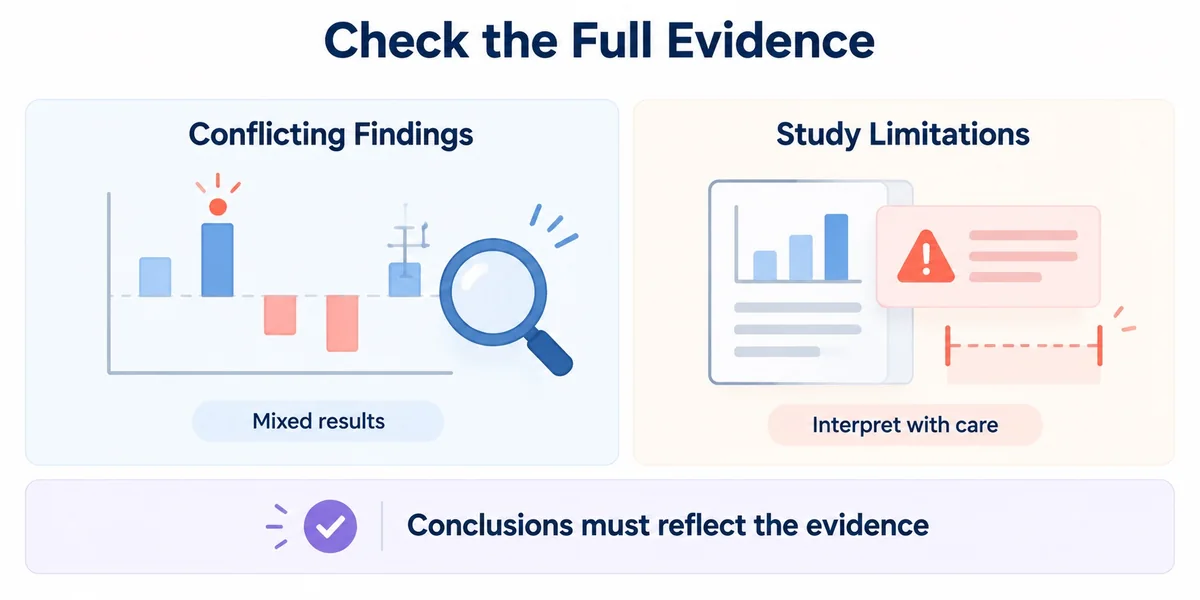
Read the unfavorable, null, and inconsistent findings alongside the highlighted result. Does the conclusion still hold when the primary outcome, secondary outcomes, subgroup analyses, and sensitivity analyses are considered together?
One positive exploratory analysis should not silently replace an inconclusive primary analysis. Differences between subgroups also need an appropriate comparison; significance in one group and nonsignificance in another do not establish that the groups differ.
Consider alternative explanations such as confounding, selection, measurement error, missing data, or an influential observation. A sensitivity analysis can test robustness to particular choices, but it cannot remove every source of bias.
6. Check Whether Limitations Change the Conclusion
A useful limitation explains its effect on interpretation. “The sample was small” is less informative than explaining that the estimate remains too imprecise to distinguish a meaningful benefit from little benefit.
After reading the limitations, return to the Abstract and Conclusion. If those sections still imply certainty, broad applicability, or clinical readiness that the limitations undermine, the manuscript is internally inconsistent.
For another check of the connection between evidence and claims, PaperProof’s AI Manuscript Checker can help flag potential gaps in the submitted manuscript. Verify each finding against the paper and available materials; an AI report does not independently validate the underlying data.
A Worked Example of an Evidence Gap
Consider a hypothetical retrospective study in which patients who used a support program had fewer readmissions. The draft concludes: “The program prevents readmission and should be adopted across hospitals.”
The reported association supports a comparison in the studied sample. The claim of prevention also needs a credible causal explanation, including attention to differences between participants and nonparticipants. The recommendation across hospitals requires evidence about transfer to other settings and implementation.
A defensible conclusion might be: “Program participation was associated with fewer readmissions in this hospital cohort. Further evaluation is needed to assess the causal effect and performance in other settings.”
That revision assumes the reported association is itself supported. If the analysis is unreliable or the result is absent, changing the wording cannot repair the evidence gap.
Final Evidence Check
Before submission, confirm that:
- Every main conclusion points to an identifiable result.
- The claim type matches the design and analysis.
- Effect size and uncertainty support the stated confidence.
- Population, setting, outcomes, and time frame stay within justified boundaries.
- Null findings and plausible alternative explanations are addressed.
- Limitations affect the main conclusion wherever necessary.
If a claim fails a check, choose an explicit response: provide relevant existing evidence, conduct a justified additional analysis, narrow the claim, or remove it. Do not invent an analysis or imply that a future study has already been completed.
Frequently Asked Questions
Does Statistical Significance Mean the Conclusion Is Correct?
No. Statistical significance does not establish that the design is unbiased, the effect matters in practice, or the conclusion applies beyond the studied conditions. Evaluate the estimate, uncertainty, design, and interpretation together.
Can a Conclusion Include Implications Beyond the Results?
Yes, when the distinction is clear. Explain how the findings motivate an implication, state the assumptions, and identify what remains untested. A possible application should not read as an established outcome.
What If the Evidence Supports Only Part of the Conclusion?
Separate the supported finding from the unsupported extension. Keep the defensible contribution, then qualify or remove the broader statement. If an additional analysis is needed, report its purpose and whether it was planned or exploratory.
Conclusion
Checking conclusions means tracing the paper’s main statements back to what was measured and analyzed, then assessing how much interpretation the evidence can carry. A clear chain from result to claim helps readers understand both the contribution and its limits.
Use this check before submission to identify the exact inferential step that needs attention. Keep supported findings precise, make uncertainty visible, and reserve untested explanations or applications for clearly labeled future work.
PaperProof
Check the Evidence Behind Your Claims
Use PaperProof to help identify potential gaps between reported evidence and manuscript claims, then review the findings and decide which changes your paper needs.
Check your evidence